THE PRODUCT
From signals to commitments — one system.
OneRank turns what your organization already knows into the decisions your roadmap is built on. From the customer feedback in your Slack threads to the engineering capacity you commit when it matters — one connected system, four layers of clarity, decisions on the cadence the market actually moves.
STEP 01 · SIGNALS
Bring scattered signals into one place.
Customer feedback. Competitor moves. Product analytics. Market shifts. Internal asks. Every product organization is drowning in scattered signals — and decisions still get made from whichever signal happened to be loudest in last week's meeting.
OneRank connects to where your signals already live. Customer-success tickets, sales call notes, board decks, market trackers, product analytics. The result is one feed, deduped and tagged — so whenever a decision needs to happen, it starts from the full picture, not the one whoever spoke last happens to remember.


STEP 02 · INSIGHTS
Turn 300 signals into
the 3 that matter.
Signal volume isn't the problem. Signal interpretation is. OneRank synthesizes across sources and surfaces the patterns that should change your roadmap right now — not when next quarter's planning meeting catches up to what your customers were already telling you in February.
Each insight cites the underlying signals. Click through to validate. Push back when the synthesis is wrong. The system learns what matters in your business, not in a generic taxonomy.
STEP 03 · TENSIONS
Make the tradeoffs explicit — before you commit.
Strategy isn't choosing what to do. It's choosing what to give up.
Most product organizations make commitments they don't realize are commitments. They ship Feature X without seeing that it costs them Feature Y. They allocate eight engineers to enterprise without knowing it postpones their self-serve growth bet by two quarters.
OneRank surfaces the tensions hiding in your roadmap. Growth versus margin. Self-serve versus enterprise. Depth versus breadth. The cost of every path becomes visible before you commit — not when the board asks why next quarter.
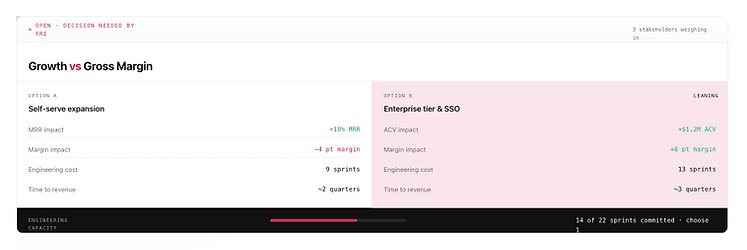
The tradeoff is named, the cost of each path is quantified, and the constraint is real. The decision happens in the open, with the same picture in front of every leader at the table.
STEP 04 · ROADMAP
Decisions become commitments.
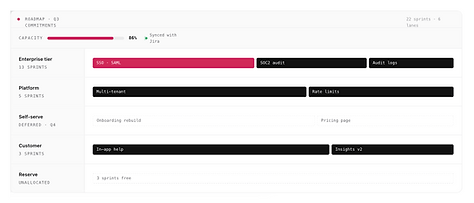
Once the decision is made, OneRank translates it into a roadmap built on real engineering capacity — not aspirational dates. The work shows up where the team is actually working: Jira, Linear, your sprint board.
When priorities shift mid-cycle — and they will — the roadmap shifts with them. Capacity reallocations don't wait for the next planning meeting. They happen when the decision happens.
Every commitment ladders back to the decision that generated it. Six months in, when an executive asks why a particular initiative made the cut, the answer isn't "because we agreed in a meeting." It's the tension that surfaced it, the option that won, and the signals that justified it. Your roadmap becomes defensible.
WHY THIS WORKS DIFFERENTLY
Decisions on the cadence the market actually moves.
Most product organizations batch their strategic decisions into quarterly planning cycles. By the time the cycle runs, the world has already moved.
A competitor shipped two months ago. A customer segment shifted. A market window opened and started closing. The plan was built on signals that were six weeks old before the meeting even started.
That's the cost nobody calculates: the opportunities that came and went between planning cycles. The competitive moves you watched but couldn't respond to until the next quarterly review. The bets you should have unwound in week three but kept funding through week thirteen because re-deciding wasn't on the calendar.
THE WAY IT USUALLY WORKS
Strategy on the planning calendar's cadence
Decisions wait for the quarterly meeting
Plans built on six-week-old signals
Bad bets fund themselves until next review
Competitor moves get watched, not answered
THE WAY ONERANK WORKS
Strategy on the cadence the market actually moves
Decisions happen when the signal lands
Capacity reallocates when the bet stops working
Tensions framed before commitments are made
Quarterly planning becomes communication, not gating
OneRank is built for the way strategy actually needs to work — continuously. When a signal lands, the system surfaces it. When a pattern forms, the insight emerges. When two priorities collide, the tension is framed. When a decision is needed, it happens — with the current picture in front of every leader who needs to weigh in.
Quarterly planning still happens. It's how the org communicates and aligns. But the decisions stop being held hostage to it. They get made when the information is fresh and the opportunity is live, then communicated upward at planning cadence — not the other way around.
The teams running OneRank stop missing windows. They stop discovering they bet wrong at the next planning cycle, three months too late. They stop watching competitors compound advantages because their own response time is measured in quarters.
That's the unlock. Not better quarterly planning. Strategy on the cadence the market actually moves.